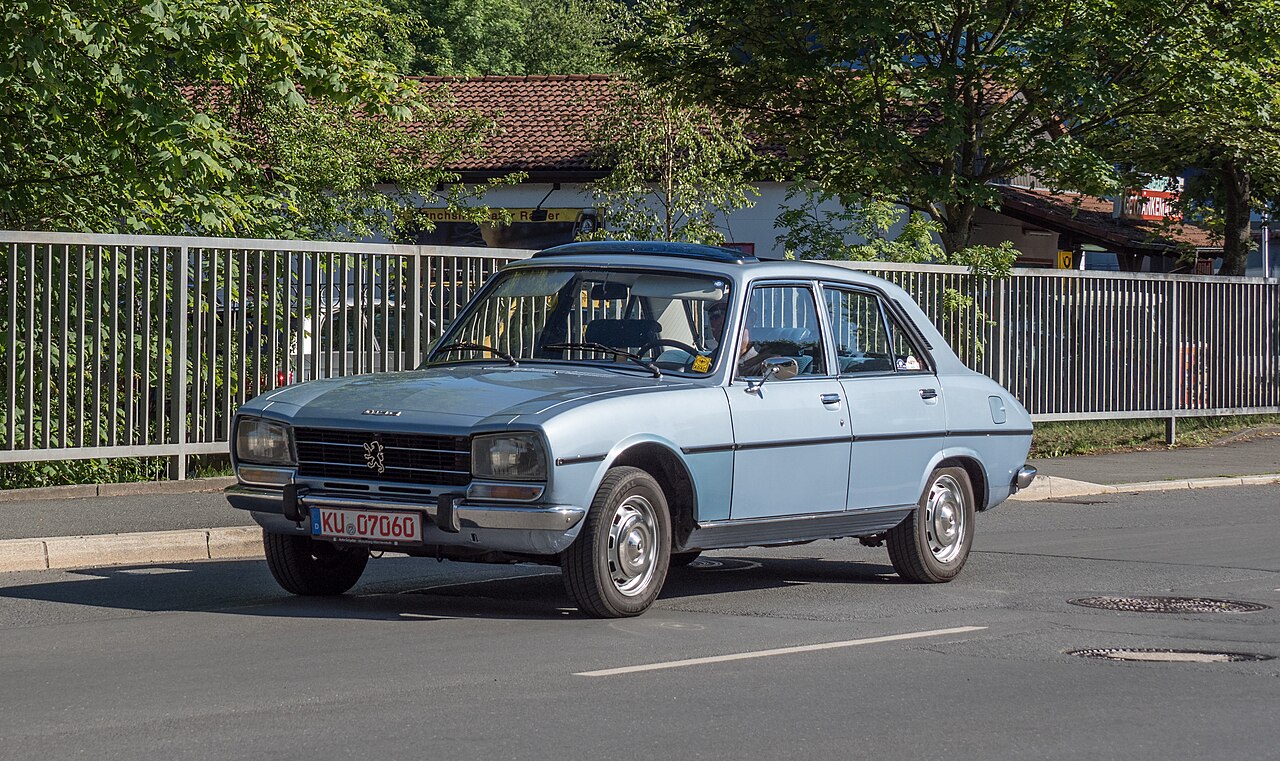
Six Continents
A Global Car
Built in France, assembled in Nigeria, Argentina, Kenya, South Africa, Australia, Spain, Taiwan, and China. Each market tells a different story.
Six Continents
Built in France, assembled in Nigeria, Argentina, Kenya, South Africa, Australia, Spain, Taiwan, and China. Each market tells a different story.
Sochaux, Doubs · 1968–1993
All European sedan, Break, Familiale, Coupé, and Cabriolet production was based at Sochaux (Montbéliard, Doubs) — Peugeot's main factory since 1912. Coupé and Cabriolet bodyshells were built by Pininfarina in Turin and shipped to Sochaux for final assembly.
The diesel variant became particularly dominant: by 1975 the 504 diesel accounted for 65% of all diesel car sales in France — driven by France's growing embrace of diesel after the 1973 oil crisis.
| Variant | Built At |
|---|---|
| Sedan | Sochaux |
| Break / Familiale | Sochaux |
| Pickup | Sochaux (1980–1993) |
| Coupé / Cabriolet bodyshells | Pininfarina, Turin |
| Coupé / Cabriolet final assembly | Sochaux |
Peugeot's official heritage arm, based in Sochaux, supports classic Peugeot owners including 504 owners — supplying some parts and documentation. They maintain the archive of historic press materials and COTY records.
The Deepest Story
Kaduna · 1975–2006
Peugeot Automobile Nigeria (PAN) was conceived in 1969 by the Federal Military Government and incorporated in December 1972. Production began March 2, 1975. Peak capacity reached 90,000 units/year with 2,000+ staff. The Nigerian operation was one of the longest-running single-model assembly programmes in automotive history. The last 504 left the Kaduna line in 2006 — 38 years after European launch.
1975–2004
Kenya assembly ran from 1975 to 2004, producing 27,000 units over 29 years. The 504's East African Safari Rally victories (1975 and 1978) were particularly impactful in the Kenyan market, where the car was already deeply embedded in commercial transport.
The long-travel MacPherson/semi-trailing arm setup absorbed potholed and unmade roads that would destroy lesser cars.
The XD88 and XD90 diesel pushrod engines could be repaired with basic tools — and a thriving trade in second-hand French parts meant components were available even in remote areas.
Higher than European market norms. African-spec pickup variants had 210mm+ clearance (Dangel 4×4).
African-spec pickups had 1,250 kg payload vs. 1,100 kg European — officially recognising real-world African loading.
The 504 Break estate became the mainstay of cross-border bush taxi trade across West Africa. Countries where it remains central to transport infrastructure:
"Even if some say it's old and only good for the breaker's yard — as soon as you find some spare parts it finds a new life."
— Insa Diaw, 56-year-old Senegalese cabbie, driving since 2002
"Africa's workhorse."
— Los Angeles Times, 2013
A 500-mile bush taxi trip cost approximately €20 ($27) per passenger. Drivers commanded premium fares for window or front seats.
SAFRAR / Sevel · El Palomar, Buenos Aires · 1969–2000
Argentina was the longest-running South American market — 31 years from 1969 to final sales in 2000. SAFRAR launched production in 1969, with the 504 becoming the best-selling car in Argentina for a significant period, surpassing the Renault 12 and Ford Falcon. In 1980 Sevel Argentina took over at the El Palomar plant near Buenos Aires.
The "Turismo Nacional" — a performance sedan built to compete in Argentina's Turismo Nacional racing category. XN1-S engine producing 110 CV at 5,500 rpm, floor-mounted 4-speed, circular headlights (vs. standard rectangular), HR high-speed radials. Top speed: 175 km/h.
A double cab pickup variant not sold in Europe — specific to Argentine commercial requirements. Produced 1983–1999 alongside the standard single cab.
Updated front and rear styling, revised interior — a significant facelift unique to the Argentine market, applied to Sevel-era cars.
| Variant | Years | Notes |
|---|---|---|
| Sedan | 1969–1999 (sales to 2000) | ~400,000+ |
| Estate (Break) | 1980–1981 only | Briefly produced |
| Pickup (single cab) | 1983–1999 | ~92,000 total |
| Pickup (double cab) | 1983–1999 | Argentina-exclusive |
Other Markets
Import market · Limited RHD
Official right-hand-drive imports were relatively uncommon. Official RHD imports ceased approximately when Peugeot discontinued the V6 in the mid-1970s. Most UK examples are four-cylinder cars. Active owner community at frenchcarforum.co.uk.
Values: Project from ~£872 · Average ~£16,029 · V6 Cabriolet up to £43,515
PACSA / Sigma · Natalspruit & Silverton · 1970–1985
Initially built at Natalspruit (near Germiston) by PACSA / PAA alongside the 404. Sigma Motor Corporation acquired PAA in 1978 for R30 million and relocated to Silverton, Pretoria. Production ended 1985 when Sigma merged with Ford to form Samcor. Variants: Sedan, Break, Bakkie, Super 7.
Renault Australia · Heidelberg, Melbourne · from 1969
Assembled by Renault Australia (not Peugeot) at Heidelberg, northern Melbourne from CKD kits — a pragmatic commercial arrangement. Only the sedan was locally assembled; Break and Familiale were imported FBU from France. Sunroof fitted as standard on launch cars. 1981 GL retail price: AUD $11,000.