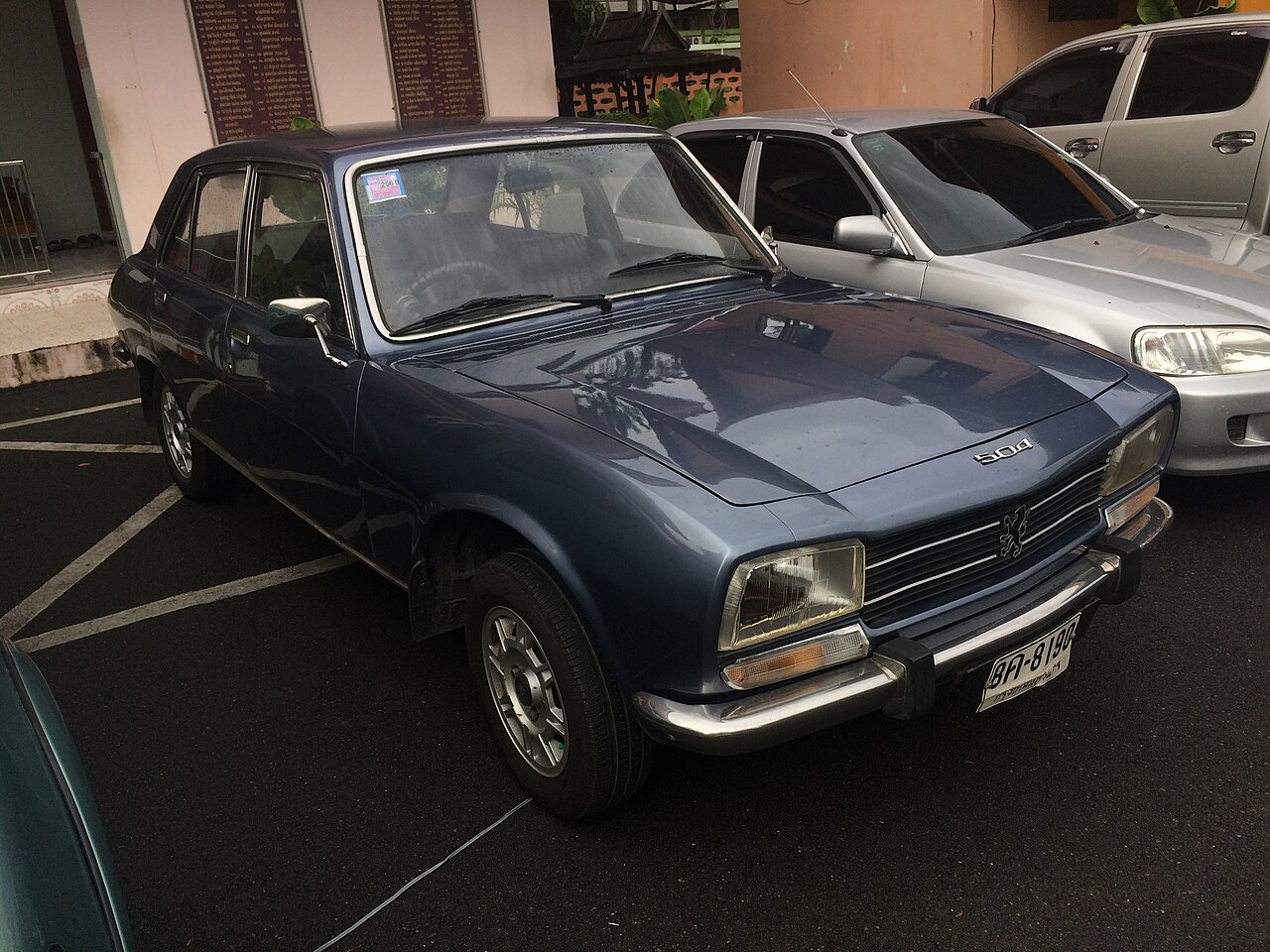
Powerplants
Six Engine Families
From the 82 hp original 1.8-litre to the 144 PS PRV V6 — and the legendary indestructible XD90 diesel that conquered Africa.
Powerplants
From the 82 hp original 1.8-litre to the 144 PS PRV V6 — and the legendary indestructible XD90 diesel that conquered Africa.
Quick Reference
| Engine | Displacement | Type | Power | Bore | Applications | Years |
|---|---|---|---|---|---|---|
| XM | 1,796 cc | I4 Petrol | 82–97 hp | — | Sedan, Coupé, Cabriolet | 1968– |
| XN | 1,971 cc | I4 Petrol | 93–104 PS | — | Sedan, Coupé, Cabriolet, Break, Pickup (Dangel) | 1971– |
| ZM (PRV) | 2,664 cc | V6 Petrol | 136–144 PS | — | Coupé, Cabriolet only | 1974–1983 |
| XC5 | 1,618 cc | I4 Petrol | 62 PS | — | Pickup only | 1980– |
| XD88 | 1,948 cc | I4 Diesel | 49–68 PS | 88 mm | Sedan, Break | 1969– |
| XD90 | 2,112 cc | I4 Diesel | 48–65 PS | 90 mm | Sedan, Break, Pickup | 1969– |
The XM is the inline-four petrol engine fitted to the original 504 sedan at launch in 1968. Available in carburetted and fuel-injected forms, with the Kugelfischer mechanical injection system fitted to the Ti variant producing 97 hp. A development of the engine family used in the Peugeot 404.
Gradually superseded by the larger XN 2.0L from 1971 but remained available through the early production years in the sedan, Coupé, and Cabriolet.
504 Sedan (1968+) · 504 Coupé (from 1969, first engine) · 504 Cabriolet (from 1969, first engine)
The XN became the standard petrol engine for most of the 504's production life, replacing the XM 1.8L. The XN1 designation covers the 96 PS variant. The top-specification injected XN (Ti variants) produced 104–106 PS. The XN family was shared across Peugeot's lineup including the 504, 505, and later models.
In Argentina, the XN1-S variant for the TN (Turismo Nacional) racing sedan produced 110 CV at 5,500 rpm — the highest-output naturally-aspirated XN fitted to a production 504.
504 Sedan · 504 Coupé · 504 Cabriolet · 504 Break/Familiale · Dangel 4×4 Pickup (XN1, 96 PS)
The PRV V6 (Peugeot-Renault-Volvo) transformed the two-door 504s from stylish four-cylinder tourers into genuinely sporting grand tourers. Introduced in the Coupé and Cabriolet in 1974, the carburetted version produced 136 PS. In 1977, Bosch K-Jetronic fuel injection was added, raising power to 144 PS — the same year the V6 Coupé gained a 5-speed manual gearbox.
The V6 Cabriolet was discontinued in 1977; the V6 Coupé continued to the end of production in 1983. The 1978 East African Safari Rally and Bandama Rally were both won by Jean-Pierre Nicolas in a V6 Coupé.
V6 Coupé carburetted: 4,472 · V6 Coupé injection: 1,157 · V6 Cabriolet: 977 — making the V6 Cabriolet extraordinarily rare.
The XC5 is notable for one specific fact: it was fitted only to the 504 Pickup — no other 504 body style used this engine. It was the entry-level petrol option for the commercial pickup variant. Most pickup buyers opted for the larger XN 2.0L petrol or the XD90 diesel.
| Specification | Value |
|---|---|
| Block | Cast iron |
| Crankshaft bearings | 5 |
| Cooling | Water-cooled |
| Indenor designation | XDP 4/88 |
| Engine family production | 1963–1992 |
The first diesel offered in the 504, introduced in 1969. The XD-family diesels were designed for longevity over performance. By 1975, 504 diesel variants accounted for 65% of diesel car sales in France — an extraordinary market share driven by fuel economy and reputation for durability. A lively trade in second-hand spare parts meant these engines could be repaired in remote villages across Africa within an hour.
The XD90 is the larger of the two Indenor diesel options — and the one most associated with the 504's legendary durability reputation. It became the definitive engine for taxi and fleet use across Africa and the Middle East, where examples routinely covered very high mileages with basic maintenance.
Durable and easy to repair without specialist tools. Accessible components.
Also used in agricultural, automotive, and industrial settings — parts were widely available.
Continued to function even with degraded oil and infrequent maintenance — critical for fleet users in remote markets.
SOHC pushrod design with accessible components. Repairable in the field with basic tools.
In sub-Saharan West Africa (Mauritania, Senegal, Mali, Burkina Faso, Guinea), XD90-powered 504 Break estates serving as cross-border bush taxis became a byword for indestructibility — running for decades on rough roads with minimal maintenance infrastructure.